The Most Common Places Surveillance Devices Are Hidden Inside Homes
I know it's hard to be sure if you are simply too suspicious, and that is how most clients come to call us convinced they are just being paranoid, only to realize afterwards that they weren't. First it is just a sense or a hunch which makes your feel something isn't quite right, and then maybe an ex who knows an awful lot about your personal life, or a business associate with whom you have always been the smartest party in the negotiations. Usually, there is the perfectly reasonable explanation. But occasionally, there is not a rational answer behind the behavior either.
If you've ever wondered where someone would actually hide a listening device or a camera in a home, the answer is: pretty much anywhere. Modern surveillance gear is tiny, cheap, and disguised to look like ordinary household junk. Some of it is sold openly online, marketed as "nanny cams" or "safety devices," and it takes about ten minutes and a screwdriver to plant.
Here's a rundown of the spots we find devices in most often, based on years of doing residential sweeps across Australia.
Smoke Detectors and Alarm Sensors
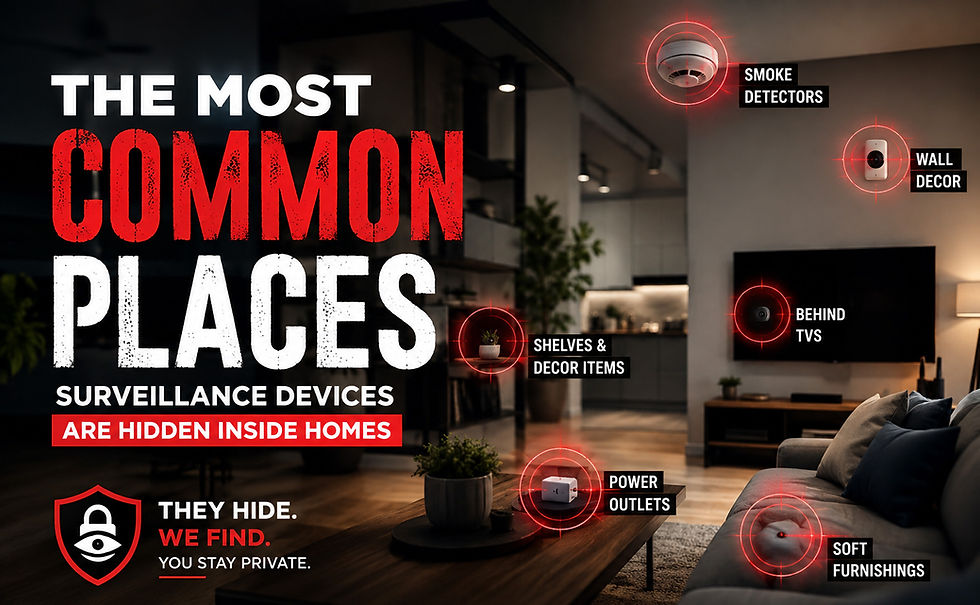
This is the classic. Smoke detectors sit on ceilings, have a clear line of sight into a room, and nobody ever looks up. A hidden camera lens fits neatly behind the plastic housing, and unless you know what a genuine detector's internals look like, it's almost impossible to spot with the naked eye. The same goes for smoke alarms, motion sensors, and even those decorative ceiling roses in older homes.
Power Points, Chargers and USB Adapters
Fake power adapters and USB wall chargers are one of the most popular disguises on the market right now. They plug straight into a power point, look completely normal, and often contain a microphone or a camera with a pinhole lens. Some even keep charging your actual phone at the same time, so nothing seems out of place. If you've got an adapter in the house you don't remember buying, that's worth a second look.
Smart Home Devices
Ironically, the gadgets we buy to make our homes safer are sometimes the ones being used against us. Smart speakers, video doorbells, baby monitors and smart TVs all have microphones and cameras built in as standard. In most cases nobody's done anything malicious to them — they're just doing what they're designed to do. But we do see cases where someone has retained remote access to a shared account, or added a device to the network without the other person's knowledge, and that's functionally the same as bugging the house.
Clocks, Picture Frames and Wall Décor
Anything that sits at eye level and doesn't move gets used as camera cover. Digital clocks, picture frames, and even fake books on a shelf are common enough that manufacturers sell them pre-built with cameras already installed. They're aimed at bedrooms and living rooms specifically because those are the rooms people assume are private.
Vents, Light Fixtures and Ceiling Fans
Air vents and light fittings give a wide field of view and a bit of natural shadow to hide behind. A small transmitter tucked into a vent cover or wired into a light fixture can run off the home's own power supply, which means the battery never needs changing and the device can stay hidden indefinitely.
Under Furniture and Inside Soft Furnishings
Old-school, but still common. A GPS tracker or audio recorder taped under a couch, tucked into a cushion seam, or stuck to the underside of a desk doesn't need power from the house at all — it just needs to be small enough not to bulge. We've pulled devices out of teddy bears, curtain rods, and even the hollow legs of dining tables.
Landline Phones and Routers
Less common now that most homes have moved away from landlines, but still worth mentioning. A phone line tap can capture calls without anyone in the house noticing anything different. Routers are a newer version of the same problem — instead of a physical bug, someone installs software that monitors traffic, browsing history, or even activates a device's own microphone remotely.
Vehicles Parked at the Property
Not technically "inside" the home, but worth a mention because we get asked about it constantly. Magnetic GPS trackers stuck to the underside of a car in the driveway are one of the most common devices we remove, and they're often planted by someone who has (or had) access to the property.
Why These Spots Work So Well
The pattern across almost every case is the same: these devices hide in plain sight, inside objects we've already trained ourselves to ignore. Nobody inspects a smoke detector. Nobody unplugs a phone charger to check what's inside it. That's exactly why they're chosen.
If something feels off — batteries draining faster than usual, strange clicking on phone calls, or someone knowing details they shouldn't — it's not overreacting to get it checked. A proper home TSCM bug sweep uses RF detection equipment, thermal imaging, and a physical inspection process that goes well beyond what you'd find scrolling a forum for tips. It's the difference between guessing and knowing.
When It's Worth Calling a Professional
DIY bug detector apps and cheap RF scanners bought online can pick up obvious, low-grade devices, but they miss anything that's been properly concealed or that only transmits intermittently. Professional TSCM technicians use equipment built for exactly this purpose, and they know where to look because they've done hundreds of these sweeps before. A home TSCM bug sweep isn't just about scanning for signals — it's a methodical, room-by-room process that covers everything above and a lot more that doesn't make it onto lists like this one.
If you're genuinely concerned about your privacy at home, the smartest move is getting a trained set of eyes and the right equipment through the door before you start guessing. Peace of mind is worth a lot more than the cost of finding out for sure.


Comments