The Hidden Privacy Risks Inside Modern Smart Homes

Smart homes are definitely a good convenience factor but not really a safeguard against privacy invasion: virtually every networked appliance, your smart speaker, doorbell camera, etc., can be used to spy on you. Malicious hackers, unhappy exes, and negligent manufacturers alike have the opportunity to make use of the very devices you bought for your home against you. The only accurate TSCM Bug Sweep that will tell you if an intruder has broken into is performed by expert technicians who are using properly calibrated Electronic Bug Detector equipment.
There's something a bit unsettling about walking into a smart home these days. The lights greet you. The thermostat already knows you're home. Your speaker is quietly "listening" for its wake word, twenty-four hours a day. We've traded a bit of privacy for convenience without really thinking about the trade, and most people never stop to ask what that trade actually costs.
We've been doing electronic sweeps in homes across Sydney for years now, and the shift has been obvious. A decade ago, most residential bug sweeps were about hidden cameras or basic listening devices planted by an ex-partner or a nosy neighbour. Now, we're increasingly walking into houses that are already bristling with dozens of legitimate, manufacturer-installed microphones and cameras — and the client has no real idea which of them could be misused, hacked, or quietly repurposed.
Your Smart Home Is Already Listening
What's actually there inside an average connected home at the moment?
A couple smart speakers. Video doorbell. A robot vacuum that maps the terrain and uses camera to do it. Smart TV models with a voice assistant already on them. Baby monitors. Also, there are now security systems to which you can connect and have a phone app with which you can watch the live feeds directly on your mobile phone. Smart bulbs and wall sockets that join to the Wi Fi in the house. All are pretty much little computers with microphones or/ and cameras. All are connected to the internet. And each one is only secure as its weakest passwords, most out-of-date firmware, the app permissions that a person tap "allow" on without reading the detail.
That's nothing but the fact of how the tech operates, not fear. The security of the hardware has failed more than once, when devices were left open to hacking or unauthorized use over the network even remotely. Considering the fact that quite a few home users keep default passwords unchanged, and rarely upgrade their hardware firmware besides this, along with a situation that a house has 5 or 6 mobile phones with saved credentials, you are really creating a vast cyberattack platform sitting in your living room.
It's Not Always a Hacker You Need to Worry About
What people tend to dislike is the fact when we come upon these sorts of problems it is often the culprit not being a stranger hacker from a foreign land who managed to break in but simply someone that knew, or was very recently close to the person, who had access to the place. It can be an ex boyfriend or girlfriend, or an employee who had to come in for some legitimate reasons, or the original system installer in the family who never had the privilege of the access being withdrawn.
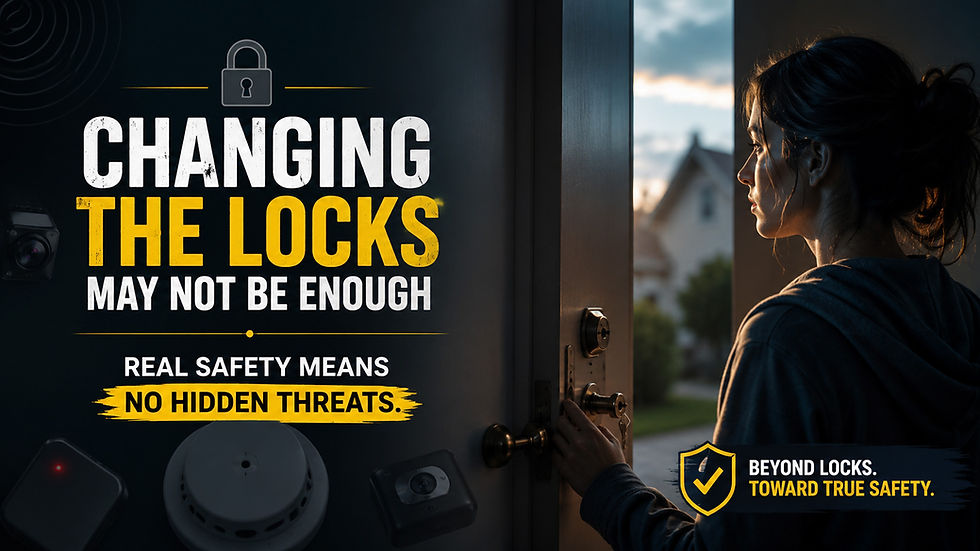
In the smart home world, the platforms revolve around shared permissions and making everything easier for people, they do not provide facilities for smoothly revoking a user from a system after relationship ends or the key is changed. For example an ex-friend who is no longer welcome at your house can still monitor camera feeds, hear everything through smart speakers or be aware of your visits by means of a smartphone app and in most cases house owners are completely clueless about the issue unless something seems very suspicious to them that something wrong is going on.
Signs Your Smart Home Privacy May Be Compromised
A few things tend to come up again and again with clients who eventually book a sweep:
Smart speakers or cameras that activate, make sounds, or show an "in use" light with nobody nearby
Devices that seem to know things they shouldn't — comments from an ex or acquaintance that reference private conversations
Unusually high data usage from a device that shouldn't be sending much traffic
Battery-powered devices draining faster than expected, suggesting they're transmitting more than normal
Unfamiliar devices connected to the home Wi-Fi network
A general, hard-to-explain feeling that someone knows more than they should
Any one of these on its own might be nothing. A pattern of them is worth taking seriously.
Why a DIY Check Isn't Enough
There's a temptation to just Google "how to find hidden cameras" and start scanning the house with a phone flashlight or a cheap detector bought online. We understand the instinct — it feels proactive, and it's free. The problem is that consumer-grade tools are built to catch the most obvious threats and miss almost everything else. They're not designed to detect devices that are transmitting on unusual frequencies, that are dormant until triggered, or that are hardwired rather than wireless.
A proper Electronic Bug Detector used by a trained technician sweeps across a far broader spectrum, picks up on RF signals that consumer tools simply aren't built to catch, and is paired with physical inspection techniques that a phone app can't replicate. It's the difference between glancing around a room and actually knowing.
What a Professional TSCM Bug Sweep Actually Covers
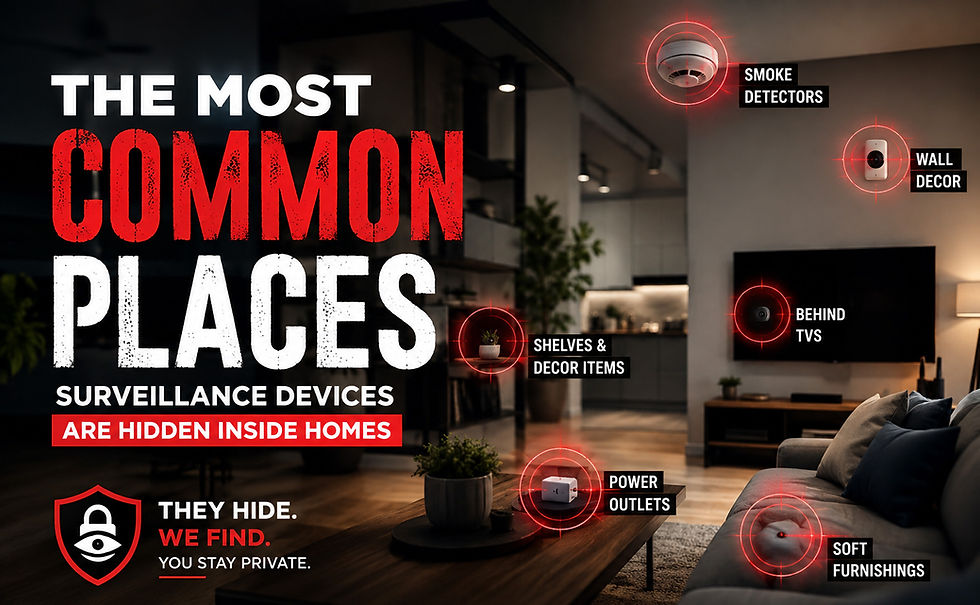
When we go through a smart home, we're not just checking the obvious gadgets. A thorough TSCM Bug Sweep looks at the whole environment: network traffic analysis to spot devices phoning home when they shouldn't be, RF spectrum sweeps to detect hidden transmitters, physical inspection of power points, smoke detectors, and other places devices get concealed, and a full audit of what's actually connected to the home network versus what the homeowner thinks is connected.
We also check the legitimate smart devices themselves. Sometimes the risk isn't a hidden bug at all — it's a smart camera that was never reconfigured after a change in household, or a speaker with permissions that were never locked down properly. Fixing that is just as important as finding something someone planted deliberately.
Taking Back Control of Your Own Home
None of this means smart homes are inherently a bad idea. The convenience is real, and most of the time, most devices are exactly what they appear to be. But "most of the time" isn't good enough when it comes to your own privacy inside your own home. Peace of mind here isn't about being paranoid — it's about actually knowing, rather than assuming.
If something has felt off, if a relationship has recently ended and access wasn't properly revoked, or if you simply want a clean baseline before you fully trust your connected home again, a professional sweep is the only way to get a real answer instead of a guess.
FAQ
How long does a smart home TSCM bug sweep take? Most residential sweeps take between one and three hours depending on the size of the home and the number of connected devices, though larger properties or more complex networks can take longer.
Can hackers really access my smart speaker's microphone? Yes, this has been documented in real-world security research and incidents. Outdated firmware, weak passwords, and unpatched vulnerabilities can all allow unauthorised remote access.
Is this only relevant for smart homes, or older houses too? Older homes without smart technology can still be targeted with traditional hidden cameras and audio bugs, which is why a full sweep looks at both electronic network risks and physical concealment.

Comments