Hidden Camera Detector: Why DIY Searches Often Miss Professional Surveillance Devices
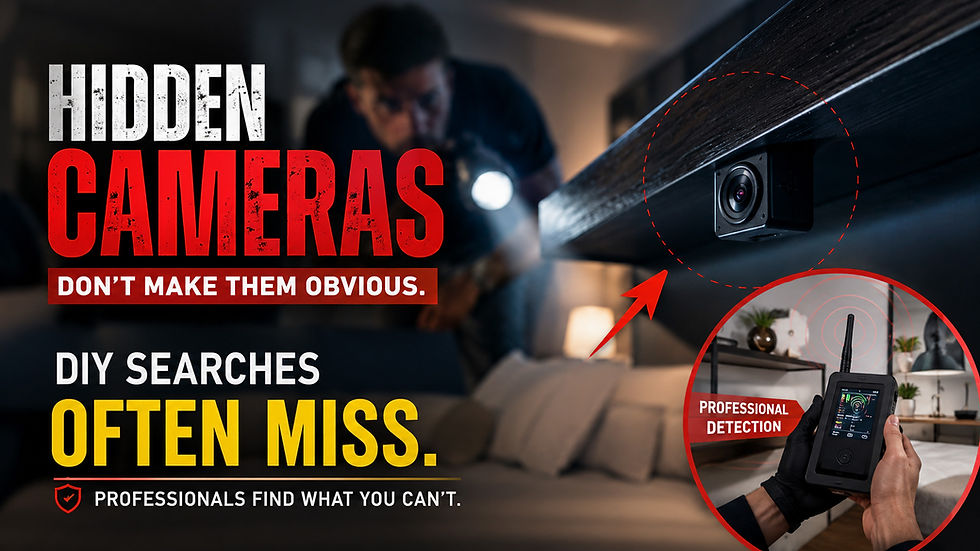
A basic hidden camera scanner or consumer-grade product only detects a camera lens glint or the basic RF signal. However it turns out that most spy cameras nowadays transmit signals encrypted, either use local storage or have Wi-Fi hopping features. Therefore, cheap detectors can't possibly catch up with these features.
For instance, if you really think that someone is watching or recording you, bug scanning (technical surveillance countermeasures) can be the only reliable way to verify your suspicions.
Cheap spy detectors have been around on the market for quite a few years. You have probably know them. Those tiny wands that are supposed to detect bugs and cameras in your house, cost less than fifty dollars usually, and the instruction says that you should detect hidden gadgets in "seconds".
Well, you point the device at your smoke detector and your eyes follow the flashing light. You feel like a superspy for four or five minutes, and then return to your routine day not wiser than before.
Here's the problem. Those devices work off a pretty narrow assumption — that whatever's spying on you is actively broadcasting on a common frequency, right now, while you happen to be scanning. That's a lot of ifs.
We are quite often contacted by folks who have already attempted the DIY path. They have bought a detector, waved it around the place Airbnb or office boardroom found nothing, and felt satisfied. Then something occurs a private conversation is repeated to them, or a video is released somewhere where it shouldn't be and it turns out that after all there was a device that was there all along. It is just not that it was transmitting at the moment they checked, or that it wasn't transmitting in a way only their $40 gadget could read.
Why Cheap Hidden Camera Detectors Fall Short
There's a reason TSCM work exists as its own trade and isn't just "buy the gadget, problem solved." A few things consumer detectors consistently miss:
Devices that don't transmit at all. A huge chunk of modern spy cameras record locally to an SD card or internal memory. No signal, nothing to catch. An RF wand is completely blind to these because there's simply no radio frequency being emitted. You could scan a room for an hour and it wouldn't matter.
Frequency hopping and encrypted Wi-Fi. Anything running on standard 2.4GHz or 5GHz Wi-Fi bands can blend straight into the noise of every other router, smart speaker, and phone in the building. Consumer detectors are tuned for a handful of common frequencies. Real surveillance gear, especially anything bought from a semi-serious supplier, is designed specifically to avoid those.
Physical concealment. This one's honestly the bigger issue in most cases we handle. A pinhole lens behind a smoke detector, inside a USB charger, drilled into a picture frame — no RF scan finds that. You need someone who actually knows where these things get hidden and has the tools to inspect it properly, not just wave a wand and hope for a blinking light.
Dormant or scheduled devices. Some units are motion-activated or set to record only during certain hours. If you're scanning at 2pm and the device only wakes up at night, you'll get a clean result that means nothing.
None of this is to scare anyone — it's just the reality of what these tools were built for versus what people actually expect from them. A basic hidden camera detector is fine for peace of mind in low-stakes situations. It's not a substitute for a real inspection when there's actual reason for concern.
What Changes When You Bring In a Professional Bug Sweep
A proper technical surveillance countermeasures examination is more than just a single tool, it is a process that is a result of different layers of measures. For instance, a high-frequency range spectrum analyser, a nonlinear junction detector capable of detecting devices even when they are turned off, and heat source detecting thermal imaging for finding devices behind walls or furniture, along with, the key part, physical inspection carried out by an experienced eye covering the places where people normally hide things.
The importance of the last item is often overlooked. Although technology makes a significant contribution, it still has its limitations. Someone who has carried out numerous sweeps is aware of the hiding spots one is likely to find in the boardroom as opposed to the bedroom or the car, and manually checks them in addition to making an electronic scan.
Besides, you should know that a genuine sweep also means receiving documentation. If something is found, you are given proof, a record and not just a vague "yes, I think it's okay". The ability to present a record to law enforcement officials, lawyers, or employer in the event, say, you have to call them in, makes all the difference.
Who Actually Needs This
Not everyone needs a full TSCM sweep, and honestly we'd rather be upfront about that than upsell someone who doesn't need it. But there are situations where it's genuinely worth doing properly rather than relying on a hidden camera detector from a hardware store:
Moving into a new rental where you can't be certain who had access before you
Business owners heading into sensitive meetings, especially around IP, legal matters, or negotiations
Anyone going through a contentious separation or custody situation
Executives or public figures who've had reason to believe they're being tracked or recorded
Short-stay accommodation, where cameras in bathrooms and bedrooms are unfortunately a recurring issue
If any of those sound familiar, a DIY detector isn't going to give you a real answer either way. You'll either get false confidence or you'll get nothing, and neither helps you actually resolve the situation.
A Few Signs Worth Taking Seriously
There's no single "tell" that guarantees you're being surveilled, but a combination of the following is worth paying attention to:
Odd objects that seem slightly out of place — a new smoke detector, an extra USB charger, a clock you don't remember buying
Small holes or fresh drill marks in walls, furniture, or fixtures
Devices that feel warm to the touch when they shouldn't be running anything
Your Wi-Fi router showing unfamiliar connected devices
Information getting out that only a small group of people should have known
Any one of these alone probably isn't proof of anything. A few of them together, especially combined with a gut feeling that something's off, is usually when it's worth getting a proper sweep done rather than second-guessing yourself with a cheap detector.
The Honest Takeaway
Hidden camera detectors aren't useless — they're just not built for the level of concern that usually prompts someone to buy one in the first place. If you're mildly curious, sure, grab one, it won't hurt. But if you're lying awake wondering whether that meeting room is actually private, or whether the last tenant left something behind, a $40 wand isn't going to settle that for you.
A professional bug sweep exists precisely because modern surveillance tech has moved well past what consumer tools can catch. It's the difference between checking and actually knowing.



Comments